
News
Calgary Home Heat Loss Analysis Now Available Through Jotson
Jotson has partnered with MyHEAT to bring aerial heat loss analysis to Calgary homeowners. If you’ve wondered why your energy bills…

Time-of-Use (TOU) electricity pricing is one of Ontario’s most common billing options and is the default for most homes and businesses. If you’re on TOU, the cost changes based on the time of day, the day of the week, and even the season.
Your utility tracks not just how much electricity you use, but when you use it. That means two identical homes — same square footage, same appliances — could have very different bills depending on habits like when they do laundry, run the dishwasher, or charge an electric vehicle.
It can be confusing at first. But once you understand how TOU works, it opens the door to smarter energy decisions and real savings. This post breaks down what you need to know — from peak-hour pricing to simple ways to make TOU work for your household.
Time-of-Use (TOU) pricing is a system where the price you pay for electricity changes depending on when you use it — not just how much you use. The idea is simple: electricity demand fluctuates throughout the day, and TOU reflects those shifts by charging more when demand is high (and supply is tight), and less when demand is low.
Ontario offers a few different pricing options, but TOU is the default for most households. We’ll touch on tiered and other alternatives in the next section.
TOU divides the day into three price periods:
With tiered pricing, you pay one rate up to a monthly usage threshold, and a higher rate beyond that. This means you need to be mindful of how much energy you’re using. Tiered pricing doesn’t care when you use electricity — just how much.
If you’re on tiered pricing and wondering if TOU is a better option for your home, check out why TOU might save you more.
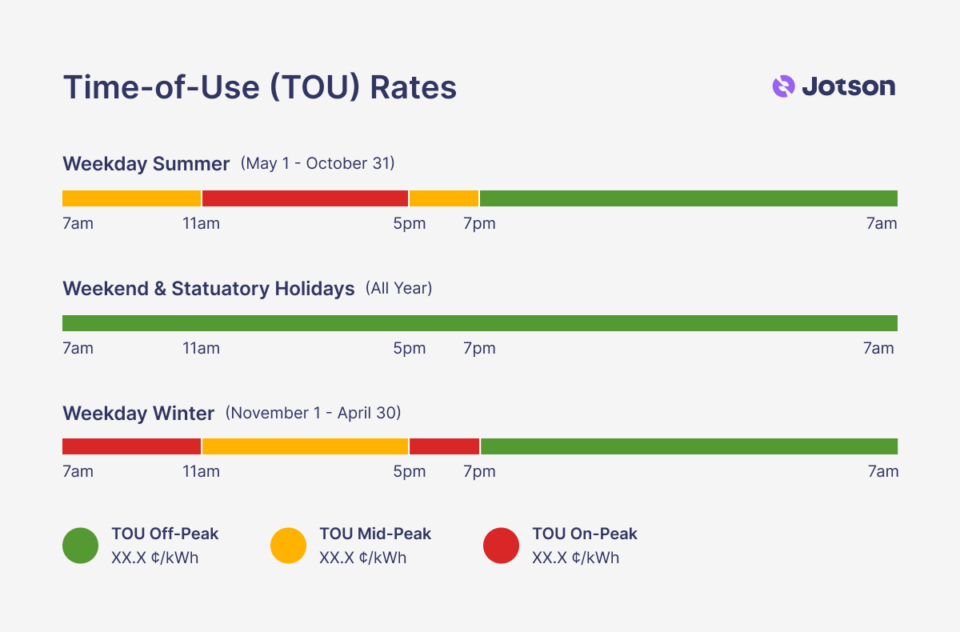
Summer Schedule (May 1 – Oct 31):
Winter Schedule (Nov 1 – Apr 30):
Weekends and all statutory holidays are always billed at the off-peak rate, no matter the time. If a holiday falls on a weekend, the off-peak rate also applies to the following weekday. You can refer to the holiday schedule here.
Looking for tips on how to use TOU hours to save money? Read our breakdown of peak, off-peak, and mid-peak TOU electricity hours.
The Ontario Energy Board (OEB) sets Time-of-Use (TOU) electricity rates in Ontario. These rates are typically reviewed and updated once a year, usually in the fall, based on detailed forecasts of energy supply costs for the year ahead — including factors like demand trends, generation mix, and market prices.
While the exact rates change over time, the structure stays the same: the more demand on the grid, the more you pay. That’s why shifting electricity use to off-peak times — like evenings, weekends, and holidays — can make a noticeable difference on your bill, especially if you’re using high-load appliances.
For the most current TOU rates, visit the Ontario Energy Board’s website.
Ontarians can choose from three different price plans: Time-of-Use (TOU), tiered, and Ultra-Low Overnight (ULO). Here’s how these three plans compare:
| Plan | Best for | Cheapest hours | Watch out for |
| TOU | Families who can shift usage | Evenings, weekends, holidays | Peak-hour spikes |
| Tiered | People home all day, steady use | N/A (flat within tiers) | Higher rates if over threshold |
| ULO | EV owners, overnight-heavy users | 11 p.m.–7 a.m. | Extremely high 4–9 p.m. rates |
If you’re still not sure which plan is right for you, we’ve got a guide to help you choose the best electricity price plan for your household.
Some of the biggest energy users in your home include:
If you can run these during off-peak hours — after 7 p.m. or on weekends — you’ll pay much less per kWh.
Not everything needs to be shifted all at once. Even small changes, like running your dishwasher before bed instead of after dinner, can add up over the month.
Technology makes TOU easier to work with. Here’s how:
Ontario’s Save on Energy program offers incentives for smart thermostats and other energy-efficient appliances. Be sure to explore these programs to boost your savings even further.
Weekends and holidays are always off-peak in Ontario. That makes them perfect for catching up on laundry, meal prep, or EV charging — without worrying about time windows. Build a few energy-heavy routines into your weekends to take advantage of the lowest rates.
“It doesn’t matter when I use power — I’m paying for it anyway.”
Not true. Under TOU, time matters just as much as how much you use — especially with high-energy appliances. The cost of power used off-peak is only 48% of the peak rate.
“The savings aren’t worth the effort.”
Even small shifts can make a difference. For example, a typical clothes dryer uses about 3.3 kWh per load. If you run it during on-peak hours (at 15.8 ¢/kWh), it costs roughly 52 cents. Shift that same load to off-peak (at 7.6 ¢/kWh), and it costs just 25 cents — less than half. Do that a few times a week, and you could save $50+ per year just from one appliance.
“I need to change everything about my routine.”
Not at all. Start with one or two easy shifts — like running laundry after 7 p.m. or using a delay-start. Small changes add up, and with a little consistency, TOU savings become second nature.
”If I switch off Time-of-Use and don’t like it, I can’t switch back”
Not true. In Ontario, you can switch between TOU, Tiered, or ULO pricing at any time — as long as you submit your request at least 10 days before your next billing cycle. That means you could technically change plans up to 12 times per year.
“I will get a larger monthly bill with TOU.”
Depends. If you’re home most of the day and can’t easily shift your usage, TOU might not be your best fit. But if your schedule allows — say you’re out during peak hours, or you can stagger tasks to evenings or weekends — you may actually come out ahead.
The 2003 blackout left over 50 million Ontarians and millions more in the northeastern United States without power. The outage was caused by operational issues, but it occurred on a hot August day when electricity demand was high — showing how peak loads can intensify grid vulnerabilities.
When too many people use power at once, it stresses the system and increases the risk of outages. That applies year-round, whether it’s heating in the winter or cooling in the summer.
TOU pricing helps prevent history from repeating by encouraging people to shift usage to off-peak times and reducing the strain on Ontario’s electricity grid.
Ontario’s electricity comes from a mix of sources — nuclear, hydro, wind, solar, and natural gas. During periods of normal demand, most of our power comes from cleaner sources like nuclear and hydro, which provide consistent, low-emission baseload electricity.
But when demand spikes — whether due to extreme weather or peak-hour usage — the system often turns to natural gas generation to meet the surge. Gas plants are faster to ramp up but produce more greenhouse gas emissions.
By shifting your electricity use to off-peak times, you’re not just saving money, you’re helping reduce the need for these less clean, high-emission sources. That small shift can lower your household’s carbon footprint and contribute to a cleaner, more efficient grid.
It’s part of the bigger picture Jotson is working toward: helping Canadians use energy more consciously, with real-time insights and personalized recommendations.
Most Ontarians don’t know whether TOU, tiered, or ULO is really working for them. Jotson gives you clear, personalized insights so you can stop guessing and start saving. Securely connect your utility today and see which plan fits your household.



Dark Apps

